
Accelerate Execution with Product Thinking

As organisations grow, teams such as HR, Finance, and Comms tend to adopt an order-taker mindset: they build exactly what internal stakeholders ask for and measure success by output (tickets closed, projects launched) rather than outcomes (value created, efficiency gained).
The result? Cumbersome processes, too many siloed solutions, and poorly adopted internal tools. Most importantly, execution becomes about completing tasks rather than delivering on strategy.
To break this cycle, organisations need to lean into Product Thinking and deliver small, functional increments based on real needs—stripping away friction, eliminating waste, and executing significantly faster. Especially now that teams are using AI to automate processes, they need to ensure that these processes not only solve the right problem, but also create the right incentives across the organisation.
What is Product Thinking?
Product Thinking is defined as the skill of understanding what makes a product useful and loved by customers—so that such customers acquire or adopt the product and the business grows.
When applied to the broader organisation, Product Thinking becomes the discipline of treating internal services, processes, and tools as scalable products that solve real business problems, for distinct users, ultimately driving measurable business impact.
That means, when an HR team designs an onboarding process, that process is a product. When a Finance team builds a controlling report, that report is a product. When an Operations team builds a vendor management workflow, that workflow is a product.
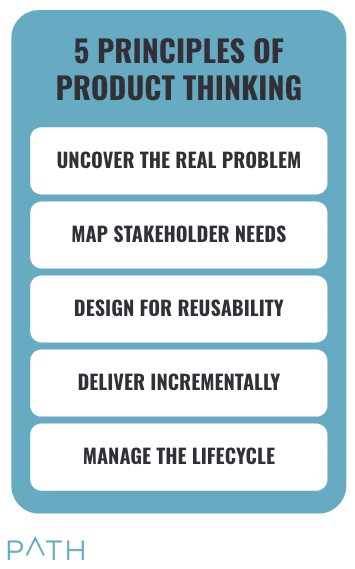
Here are the five principles to embed Product Thinking across your entire business:
1. UNCOVER the Real Problem
In a traditional internal service model, a stakeholder asks for a specific dashboard or a new approval process, and the team builds it exactly as requested. With Product Thinking, the team approaches the request with curiosity. They move from fulfilling an "ask" to investigating the real problem behind it. The key practices are to never accept a solution at face value, to establish a discovery partnership with internal stakeholders, and to explain that you need more information before moving into delivery. Make sure to ask open-ended questions about what they are trying to achieve so that you understand how the new solution will create tangible business impact. Ask about what alternatives they currently have so that you can uncover pain points and workarounds. Avoid creating long, asynchronous intake forms that force internal users to describe the exact solution they think they need in detail. Instead, use a lean form that allows your team to track requests without attempting to replace the discovery process.
2. Map Stakeholder NEEDS
Non-product teams often treat their internal audience as a single, homogeneous group. A common failure is designing a solution that satisfies a senior leader but is completely unworkable for the team member using it daily. High-value solutions are built at the intersection of three perspectives:
The employee who interacts with the tool or process daily. Their need is simplicity, speed, and ease of use.
The internal business partner requesting or sponsoring the initiative. Their need is immediate business impact and operational visibility.
The senior executive whose broader strategic goals must be respected. Their need is to ensure strategic alignment, governance, and compliance.
Make sure you understand all their needs, but ensure the solution solves the problem and delivers the expected impact instead of trying to satisfy everyone's individual wishes.
3. Design for reusability
When teams operate in silos, they build bespoke, hyper-customised solutions for every individual request. This leads to dozens of fragmented dashboards, isolated operational workflows, and duplicated efforts. Make sure you move from building one-off fixes to designing a modular portfolio of solutions. Before building anything new, look for shared patterns across the organisation. Aim to build a core, foundational solution that solves 80% of the problem for multiple departments, leaving room for light, intentional customisation. And make sure you avoid the "Frankenstein" trap—creating a single, massive process or tool that tries to be everything to everyone, making it difficult to use and impossible to maintain.
4. Deliver incrementally
With Product Thinking, teams measure success by the speed of value delivery instead of the simple completion of a project. Instead of waiting six months to launch a massive process, deliver a "slice of value" within weeks. If you are redesigning an internal employee portal, for example, launch one highly requested feature flawlessly first. Then gather real usage data, adapt to behaviour, and build the next item based on evidence, not assumptions. But be aware: building iteratively does not mean delivering a broken or low-quality first experience. The first increment should be minimal, but must remain functional and valuable.
5. MANAGE the lifecycle
The most common mistake in corporate planning is assuming that the effort ends at launch. In reality, launching a new process or tool is only the first 20% of the lifecycle. The remaining 80% is driving adoption, maintaining relevance, adapting to changes, and eventually decommissioning it. Most often than not, you are not launching one-off projects, you are managing lifecycles of tools, processes or workflows. Remember: every new internal tool or process creates some level of operational debt. If your team lacks the capacity to maintain, support, and iterate on a solution over time, question whether you should build it in the first place. When a solution loses its utility, it must be intentionally retired to stop draining organisational energy—make sure you conduct regular reviews of your products' actual value.
The Strategic Takeaway for Leadership
Embedding Product Thinking into non-product teams fundamentally transforms how your organisation operates. It elevates internal departments from cost centres that execute tasks into value centres that co-create business outcomes.
The next time you review an internal roadmap or operational bottleneck, don't ask your teams what they are delivering. Ask them what organisational friction they are removing, who they are removing it for, and how they plan to measure the impact.
That is how you accelerate value delivery at scale.
I’m Carolina Castanheira. I help scaling companies build portfolio governance and product operations that accelerate strategy execution—without compromising their culture. Let’s talk.


Comments